
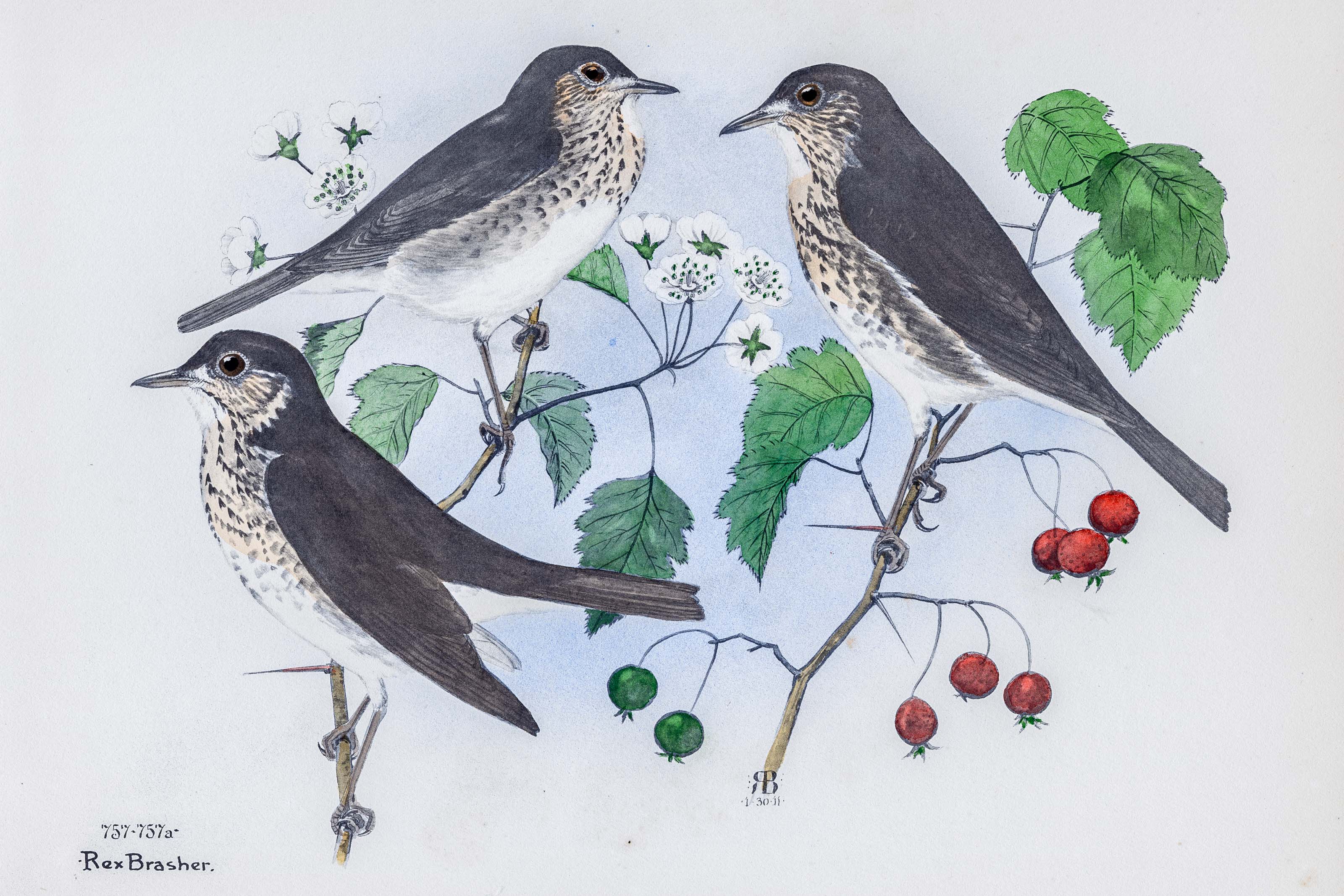

Troubadours who "bill" recitals from Peru to the Arctic Circle are the ALICIAE. In Alaskan lands of the midnight sun their song is heard for twenty hours of daylight out of twenty-four. John Burroughs heard them singing continuously from 2 A. M. to 10 P. M. near Port Clarence north of Behring Strait. One performer hovered above the tundra and repeated its song three times in rapid succession. Lacking tree perches in that unarborescent land the bird used the air instead.
The song is said to resemble the Veery's but is thinner in quality and the call note given impatiently with ascending pitch.
NEST: in low trees within 10 feet of ground, compact and bulky, built of interwoven bark, grass and leaves, sometimes composed almost entirely of dried moss.
EGGS, 3 or 4, greenish blue specked with rusty and yellowish brown.
Northern and eastern North America. Breeds in Hudsonian zone in narrow belt just south of tree limit in northwestern Alaska and Mackenzie thru central Keewatin and Ungava to Newfoundland. Migrates southward thru eastern United States. Winters in northern South America.
Eastern North America. Breeds in Hudsonian and upper Canadian zones in Nova Scotia, mountains of northern New England, the Catskills and Adirondacks of New York and probably in west Massachusetts mountains.
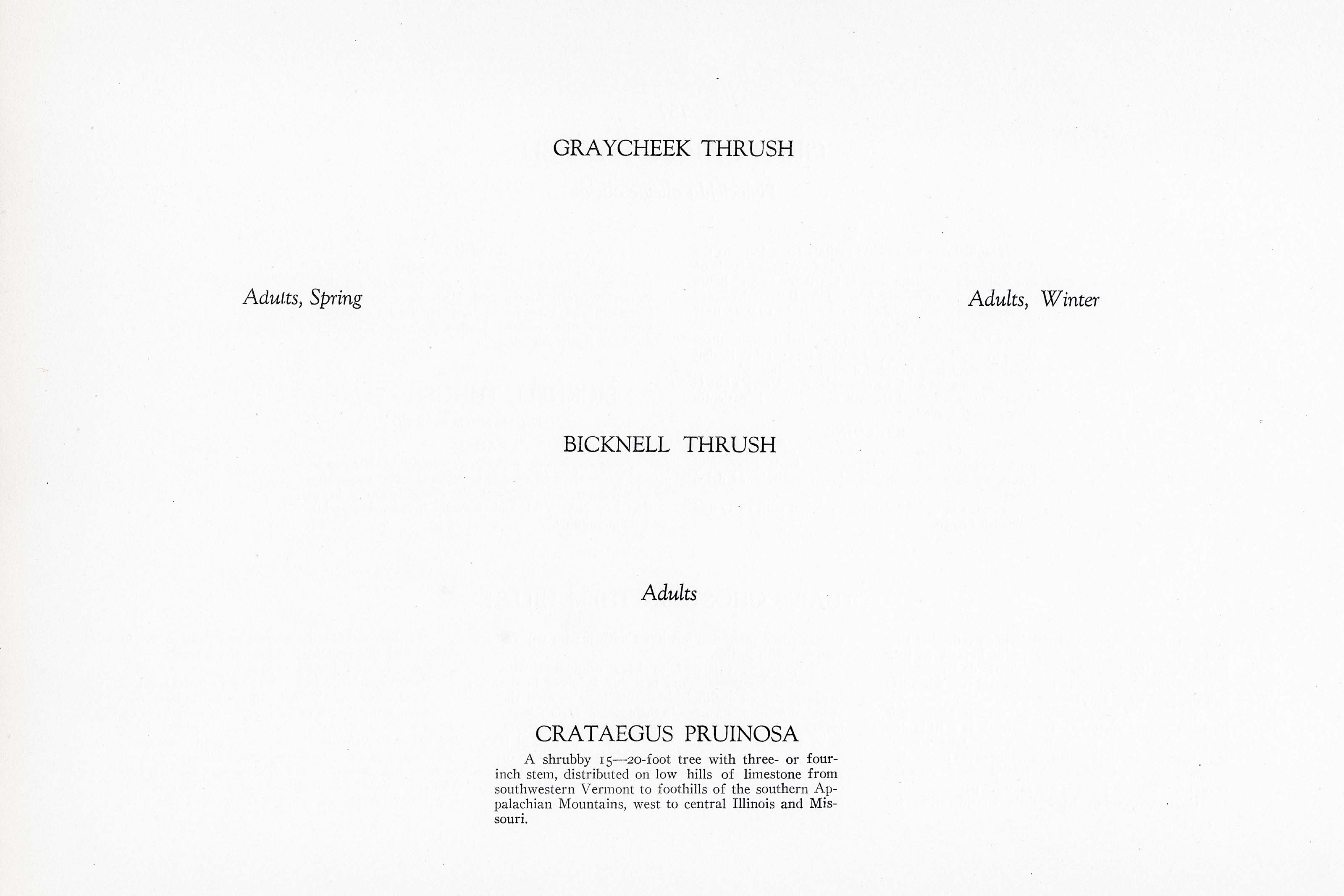
A shrubby 15–20-foot tree with three- or four-inch stem, distributed on low hills of limestone from southwestern Vermont to foothills of the southern Appalachian Mountains, west to central Illinois and Missouri.