
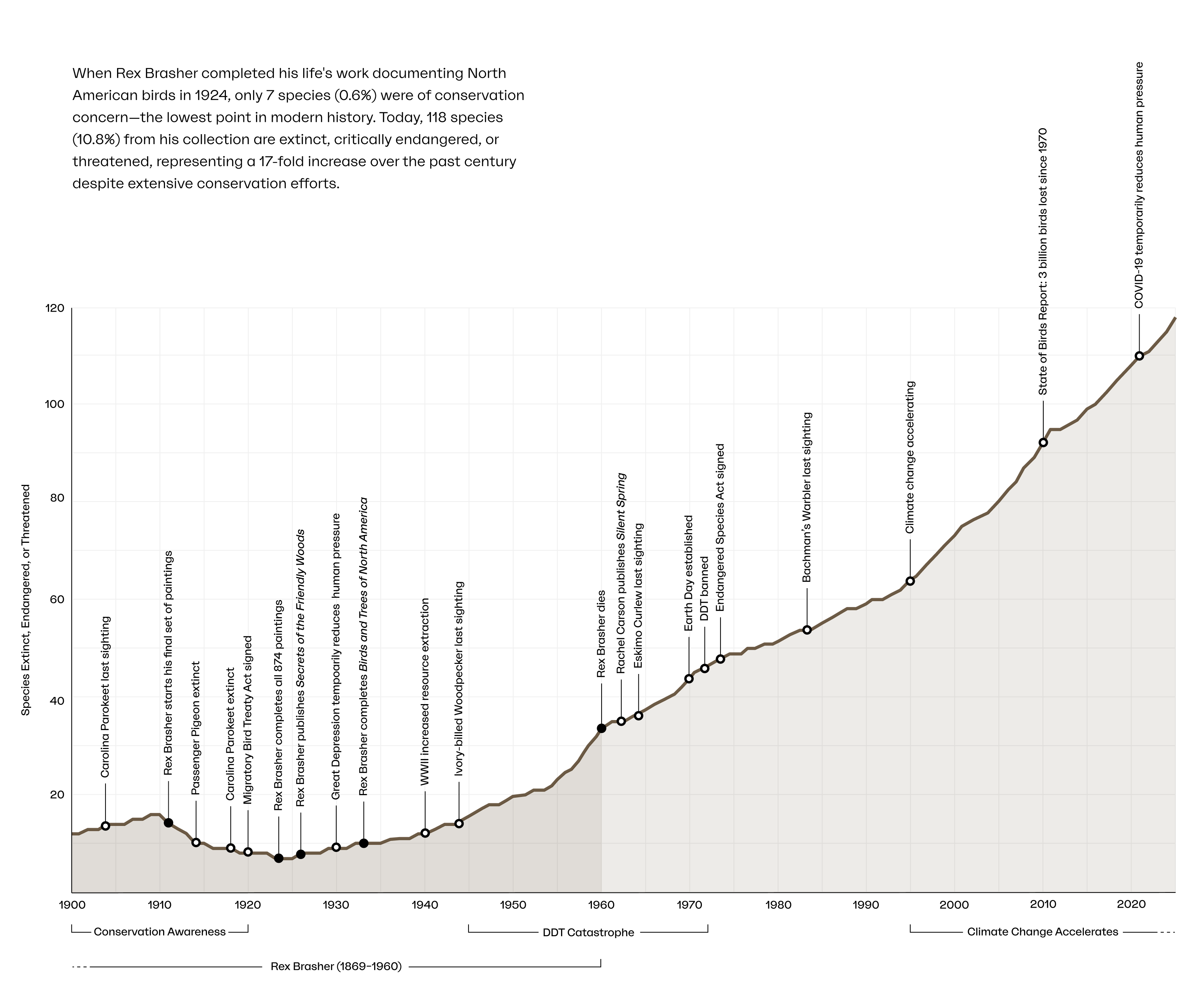
When Rex Brasher completed his life's work in 1924, nearly all 1,097 species he painted were alive and observable in the wild. Today, two are extinct, four are critically endangered (possibly extinct), and 114 more face varying degrees of extinction risk. Most troubling: half of all assessed species are experiencing population declines, suggesting that many currently secure species may become threatened in the coming decades without conservation action.
Rex's collection has transformed from a celebration of North America's avian abundance into a powerful reminder of what we stand to lose—and what we still have time to save.
Bird species in Rex's collection that have become extinct, endangered, or threatened since he observed them in the wild.
According to the IUCN Red List, there is no reasonable doubt that the last individual of these species has died. Rex Brasher painted these birds when they still flew across North America. Both species were driven to extinction by human activity—the Passenger Pigeon through overhunting and habitat loss (the last individual died in 1914), and the Carolina Parakeet through habitat destruction and persecution (the last was confirmed in 1904). Their extinction occurred during or shortly after Rex's lifetime, making his paintings some of the last visual records of these species in life.
According to the IUCN Red List, these species face an extremely high risk of extinction in the wild. Without immediate and sustained conservation action, these birds may follow the Passenger Pigeon into oblivion. Three of these species (Bachman's Warbler, Eskimo Curlew, and Ivory-billed Woodpecker) are listed as "Possibly Extinct" and have not been reliably observed in decades. The California Condor represents a remarkable conservation success. Though it remains critically endangered, intensive captive breeding has brought the population from 27 individuals in 1987 to over 300 wild birds today.
According to the IUCN Red List, these species face a very high risk of extinction in the wild. These 13 birds represent 1.4% of Rex Brasher's collection and require urgent conservation intervention to prevent further decline. Many face threats from habitat loss, climate change, and human disturbance. The Whooping Crane has been a conservation priority for decades, with intensive management keeping the species from extinction. The Tricolored Blackbird has experienced catastrophic declines of over 90% since Rex's time due to agricultural changes in California's Central Valley.
According to the IUCN Red List, these species face a high risk of extinction in the wild. Nearly 40 species that Rex observed and painted — 4.2% of his collection — are now vulnerable to extinction. This category includes many seabirds threatened by climate change and ocean acidification, shorebirds losing critical stopover habitat, prairie grouse decimated by agricultural expansion, and declining aerial insectivores like swifts facing mysterious population crashes.
The Evening Grosbeak, once abundant at bird feeders across the continent, has declined by 92% since 1970. The Rusty Blackbird has lost 85-95% of its population in the past 40 years, with causes still not fully understood.
According to the IUCN Red List, these species are not currently endangered or vulnerable but are close to qualifying or are expected to qualify for a threatened category in the near future.
With 60 species — 6.5% of Rex's collection — classified as near threatened, these birds represent an early warning system. Many have already experienced significant declines and could move into more severe threat categories without conservation action. The Bobolink has declined by 65% since 1966 due to earlier hay mowing that destroys nests. Brewer's Blackbird has decreased by 85% in the past 50 years. The Northern Bobwhite, once one of the most abundant gamebirds in America, has lost 85% of its population since 1966 due to habitat loss and agricultural intensification.
According to the IUCN Red List, these species are plentiful in the wild and do not currently qualify for endangered, vulnerable, or near-threatened status.
The vast majority of birds Rex painted — about 87% of his collection — are still relatively secure today. This includes many familiar backyard birds like the American Robin, Northern Cardinal, and Black-capped Chickadee, as well as numerous waterfowl, seabirds, warblers, and raptors. However, "Least Concern" does not mean populations are stable. Many species in this category are experiencing significant declines, but remain abundant enough that extinction risk is currently low. North America has lost 3 billion birds, approximately 29% of its total avifauna, since 1970, with many "Least Concern" species contributing to this loss.
While these 805 species are not currently threatened with extinction, approximately half are experiencing decreasing populations according to IUCN assessments. The designation "Least Concern" reflects current extinction risk, not population health or trend.